
Obituary
Published online : 17 December, 2025
Professor of Anesthesiology and Molecular Physiology & Biophysics,Vanderbilt University School of Medicine, Nashville, TN.
Peter Kurt Lauf, MD passed away in Louisville, Kentucky,on February 03, 2025. He was born on September 25, 1933, in Freiburg im Breisgau, Germany. After attending medical school at the University of Freiburg from 1954 to 1958, he moved to the United States to undertake a long and prestigious academic career.
Prior to becoming a transport physiologist, Peter Lauf was an accomplished biochemist. He started his career in the US at Wayne State University in Detroit, Michigan, where he worked on methods to isolate proteins from red blood cell membranes. A paper published in 1965 indicates his pioneering work in the study of membrane proteins [1]. In this Nature publication, he wrote: “The application of urea starch-gel electrophoresis to the investigation of the red cell membranes offers new insight to the complexity of the constituents of such membranes”. Building on these discoveries, Peter soon shifted his focus from biochemistry to transport physiology, a transition that would define the rest of his scientific career.
He was then recruited at Duke University by Daniel Tosteson, who was most famous for his concept of pump and leak [2]. Together they set to characterize cell surface antigens to account for a cation dimorphism that exists in the red blood cells of ruminants [3]. Sheep for instance, inherit traits that result in either high potassium-containing (HK, i.e. 80 mM) or low potassium-containing (LK, i.e. 16 mM) red blood cells [4]. Peter showed that HK cells have a 4-6 times higher activity of the Na+/K+-ATPase, compared to LK accounting for a higher K+ concentration, and was able to develop an antibody (anti-L antibody) that increased the activity of the pump when given to LK cells [5, 6]. Further work using tritiated ouabain revealed that this anti-L antibody increased the affinity of existing pump to the inhibitor but did not provide evidence that the antibody was recruiting new pump sites at the red cell membrane [7]. Efforts were then made to identify the L-antibody antigen using highly purified 125I-labeled antibody, but while he gathered information that excluded the Na+/K+ pump, the identity of the antigen was not revealed. Towards the latest part of his active research career, Peter considered revisiting this issue with updated techniques but unfortunately did not get to do it.
While the identity of the sheep red blood cells antigens related to K+ pump and K+ leak were not identified, a significant breakthrough in red blood cell transport physiology came when Peter Lauf uncovered a chloride-dependent, N-ethylmaleimide stimulated, K+ leak in low K sheep red cells [8]. Simultaneously, colleagues at Oxford University England identified a similar chloride-dependent, in this case cell swelling-stimulated, K+ leak in human red blood cells [9]. This co-discovery started a field of investigation which today covers 2400 papers on K-Cl cotransporters listed in Pubmed®, and involves diseases such as sickle cell anemia, epilepsy, deafness, peripheral neuropathies, and acid/balance disorders in kidney.
The original discovery described a unique transport process likely mediated by a single protein unit, which is distinct from other units transporting ions across the cell membrane. Until the identification of the gene(s), this K-Cl cotransport process was studied almost exclusively in red blood cells. Indeed, over the 20 years that followed the initial discovery of K-Cl cotransport, Peter Lauf characterized its most fundamental properties in sheep red blood cells: ion affinities, ion selectivity, kinetics, inhibitor selectivity and affinity, regulation by metabolism, calcium, magnesium, pH, ATP, etc. During the same period, other investigators studied the cotransporter in human, rabbit, dog, and pig RBCs. One early observation from Lauf that stands out is the activation of a Cl--dependent K+ flux in cells exposed to the divalent ionophore A23187 [10], while inhibition when the ionophore was applied in the presence of 1 mM Mn2+ or Mg2+ [11, 12]. This observation, although seemingly contrary to the requirement of ATP, was an early indication that a protein kinase might be involved in the inhibition of K-Cl cotransport. We now know that phosphorylation/dephosphorylation is the major mechanism by which K-Cl cotransport in all cells is regulated.
The cloning era of the transporters started in earnest with the release of the sequence of the cDNA encoding the fish thiazide-sensitive Na-Cl cotransporter [13]. While all Na+-dependent cation-chloride cotransporters got identified right after, it took some additional efforts to identify the first K-Cl cotransporter [14]. Peter Lauf and his wife, longtime collaborator Norma Adragna, also participated in the race. They released the sequence of the sheep (Ovis aries) KCC1 cDNA in 2003 (GenBank: AF515770.1). Over the following years, they published additional work, studying KCC1, KCC2, KCC3, and KCC4 in glial cells, vascular smooth muscle cells, lens epithelial cells, and human red blood cells from patients lacking KCC3 expression [15-20].
In the mid-1980s, Peter moved to Dayton, Ohio, to build a Physiology Department at Wright State University. In 1986, Peter created OPS, the Ohio Physiological Society, a professional association of Ohio Physiologists; and in 1995, with the blessing of Marty Frank, executive director of the American Physiological Society, and of the society’s council, OPS became the prototype for many state chapters to come. Peter was a driving force behind the creation of many of these chapters [21].
Peter was a true renaissance man, highly informed as an avid reader of humanities, politics, and science. He was also an accomplished musician with a particular interest in the baroque and classical periods. I remember many long road trips taken in his car (always a Mercedes-Benz), with a classical radio station playing Händel, Bach, Mozart, or Schumann. He loved entertaining, playing piano or harpsichord, accompanying his son playing the cello.
Peter was shaped early on by the years leading to World War II, the bombing of his hometown in May 1940 (German mistake) and the more severe bombing by the Royal Air Force of November 1944, which killed nearly 3000 of his neighbors. Because of these experiences, he was very much affected by the new political trends and ever-increasing polarization in the United States. As a leader, he always had respect for individuals that did not share his opinions and was often conflicted about the human aspects, the consequences of his decisions. He was a truly deep, caring, and loving individual.
Peter Lauf’s legacy survives in the lives of the many students he has taught, the many scientists he has trained, and of his family and friends. His work will endure in the scientific literature and the generation of scientists, that will rely on his insights and discoveries.
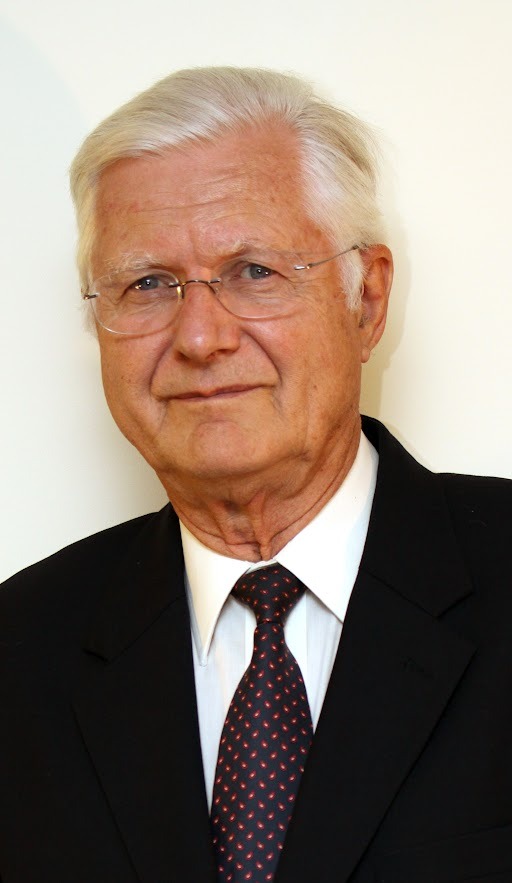
Peter K. Lauf - † 2025